Independent technical report · August 2026
Hondurasgate: A Forensic Analysis of the Audio Verification
On the inconsistencies in hondurasgate.ch's «Informes Forenses de Autenticación de Voz» ("Voice Authentication Forensic Reports")
This report does not analyze whether the Hondurasgate recordings are real or fake. That question requires access to the original files at their native resolution — files that have never been published.
This report analyzes exclusively the verification method that was used, and demonstrates, with reproducible evidence, that this method does not prove what it claims to prove.
Personal, self-funded investigation: the entire cost of the experiment was $22. No commission, no client, and no relationship with any of the parties involved — not hondurasgate.ch, not Drop Site News, not Earshot, not Phonexia.
The story in one paragraph: hondurasgate.ch presented its 37 audio files as verified with Phonexia's forensic software. Phonexia denies any involvement, demanded the removal of its name, and hondurasgate deleted the references within five hours. The "verification panel" is a fabricated interface that no Phonexia product generates, run on audio degraded to 8,000 Hz — the resolution that removes precisely the frequencies where AI synthesis is detected. And the proof that the method proves nothing: a voice clone created in two hours for $22 passes exactly the same verification.
1Context: what Hondurasgate is
On April 30, 2026, the anonymous platform hondurasgate.ch — operating from Switzerland in collaboration with Canal Red (Spain) and Diario Red — published 37 audio recordings supposedly extracted from WhatsApp, Signal, and Telegram. The recordings are attributed to former Honduran president Juan Orlando Hernández (JOH), current president Nasry Asfura, and congressman Tomás Zambrano, among others.
The recordings allege an international conspiracy to destabilize left-wing governments in Latin America with support from the United States, Israel, and Argentina.
To support the authenticity of these audio files, hondurasgate.ch published what it called a "forensic dossier" with individual verification reports for each file. These reports carry the name and logo of Phonexia Voice Inspector, a Czech voice forensic analysis company.
This report analyzes those verification reports.
REF Hondurasgate on Wikipedia: en.wikipedia.org/wiki/Hondurasgate
2What they claim: the forensic verification panel
For each of the 37 audio files, Hondurasgate published a verification panel on its website and a downloadable PDF report. The panel shows:
- A green verdict: VOZ HUMANA CONFIRMADA ("HUMAN VOICE CONFIRMED") — the downloadable PDF downgrades it to «VOZ HUMANA» ("HUMAN VOICE")
- Six authenticity metrics (acoustic naturalness, spectral coherence, pitch naturalness, microprosody, breathing, background consistency)
- An AI probability (5.39%) and a confidence score (88.9% on the panel; 88.0% in the PDFs)
- A SHA-256 hash — a cryptographic fingerprint of the file — presented as a "chain of custody"
- The stamp "Phonexia Speech Platform 3.2.1 · Voice Inspector," plus references to ISO 27037 and ENFSI BPM
- A section describing processing via the "Phonexia REST API"
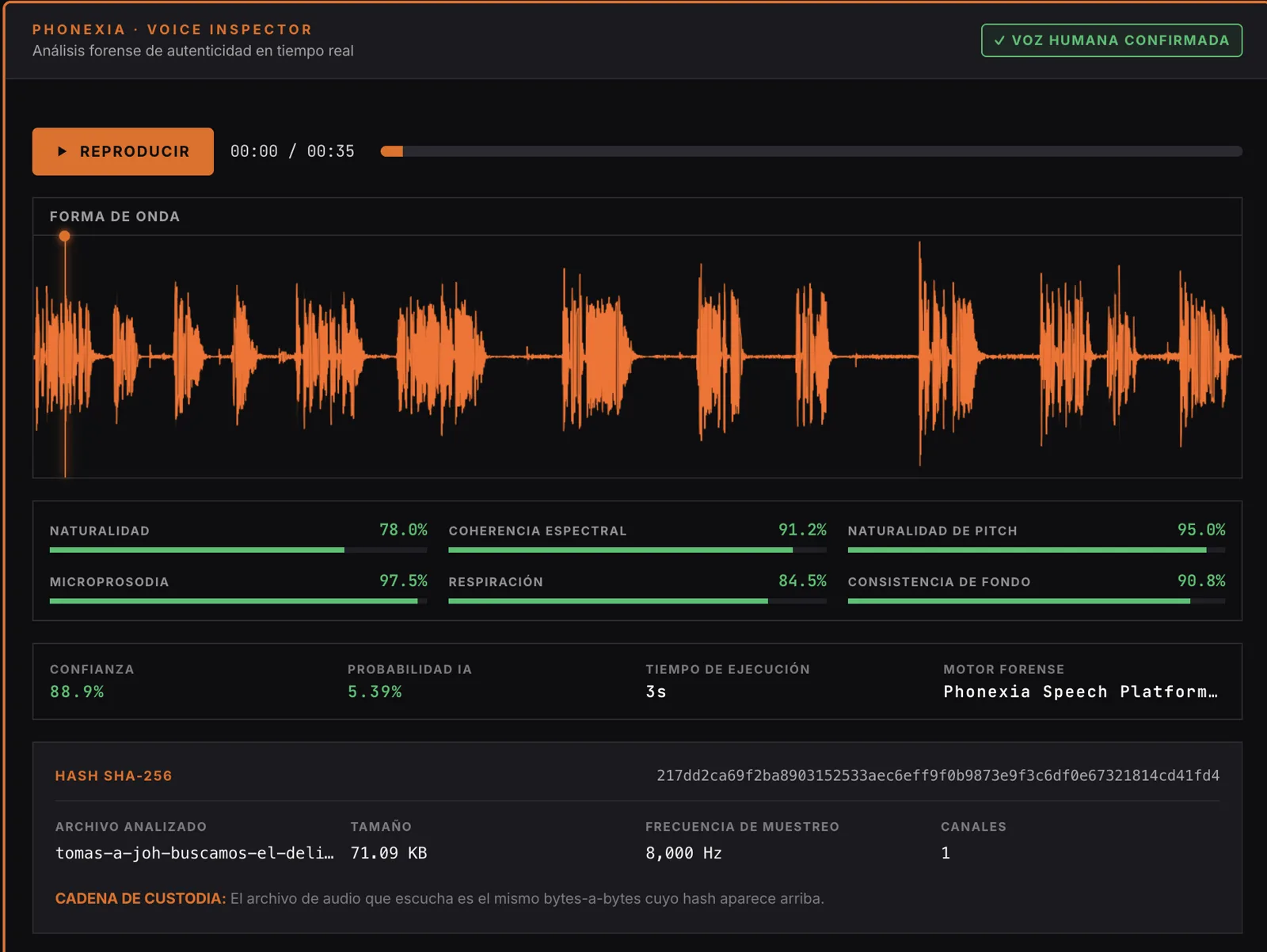
217dd2ca… — presented as "Phonexia · Voice Inspector."Each of these elements contains a fundamental error. We analyze them one by one.
3Error 1 — Phonexia was not involved
On May 20, 2026, Phonexia published an official statement on its corporate blog:
- Phonexia's software was not used in connection with hondurasgate.ch's materials
- All references to Phonexia were made without authorization
- There is no relationship of any kind — commercial, technical, licensing, or partnership — with the operators of these publications
- The materials contain numerous factual, conceptual, and technical inaccuracies about Phonexia's technology
- Phonexia has formally demanded the immediate removal of all unauthorized references
Hondurasgate confirmed to Contracorriente (an independent Honduran outlet founded by journalist Jennifer Ávila) that it used Phonexia's branding "without having explicit commercial authorization."
Within five hours, the website replaced every reference to Phonexia with a supposed "HG Forensics" — an entity with no verifiable presence in any registry.
They didn't defend the reports when they were caught: they deleted them. When the spotlight moved on, they put them back up.
REF Phonexia statement: phonexia.com/blog/statement-regarding-honduras-gate…
REF Contracorriente (May 18, 2026), "Phonexia niega el uso de su herramienta en Hondurasgate" ("Phonexia denies use of its tool in Hondurasgate") — documents "HG Forensics" and the five-hour window: contracorriente.red
REF Analysis via Dromómanos/Substack: dromomanos.substack.com
4Error 2 — Wrong product, wrong tool
The panel reports claim to have used Phonexia Voice Inspector. This reveals a fundamental misunderstanding of what this software does.
Phonexia Voice Inspector is desktop forensic software designed for speaker comparison — that is, to determine whether Speaker A in one recording is the same person as Speaker B in another. It is a voice-identity tool, not a deepfake detector.
What the reports claim to do — determine whether an audio file was generated by AI or recorded by a human — requires a completely different product. Phonexia offers three tools for that:
| What they needed | What they used (allegedly) |
|---|---|
| Authenticity Verification | Voice Inspector (speaker comparison) |
| Deepfake Detection | Voice Inspector (speaker comparison) |
| Referential Deepfake Detection | Voice Inspector (speaker comparison) |
It's like using a microscope to measure temperature. The tool is real. The use is absurd.
Phonexia's official documentation describes Voice Inspector as a tool for speaker comparison ("automatic forensic voice comparisons in compliance with the ENFSI guidelines") — not as a synthesis detector. Artificial-voice detection is a separate Phonexia product ("Deepfake Detection"). Moreover, the official technology list for Speech Platform 4 (Age Estimation, Authenticity Verification, Deepfake Detection, Speaker Identification, Speech to Text, etc.) contains no technology or endpoint called "voiceinspector." The panel claims to have used a REST endpoint (/technologies/voiceinspector) that does not exist in the documentation.
REF Voice Inspector, speaker comparison: docs.phonexia.com
REF Deepfake Detection, separate product: docs.phonexia.com
REF Official Speech Platform 4 technology list (no "voiceinspector"): docs.phonexia.com
5Error 3 — The interface is fabricated
The hondurasgate.ch panel displays a visual verdict: a green badge reading «VOZ HUMANA CONFIRMADA» (or, in English on some instances, "HUMAN VOICE CONFIRMED"), surrounded by colored progress bars for six metrics.
Phonexia Voice Inspector does not produce this kind of output. The real software returns:
- A numeric score in JSON format (a −10 to +10 scale for deepfake detection, or a likelihood ratio — a probability ratio — for speaker comparison)
- It does not generate green badges, progress bars, or binary "CONFIRMED / NOT CONFIRMED" verdicts
- It does not calculate the six metrics shown (acoustic naturalness, spectral coherence, etc.)
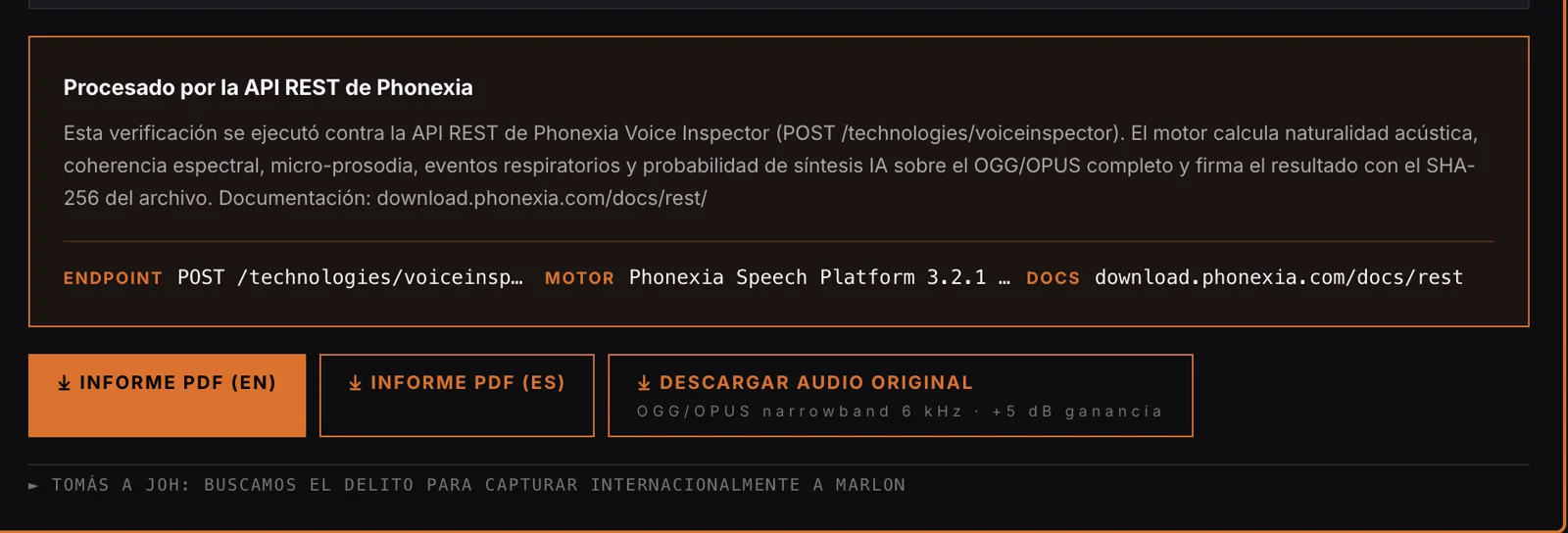
POST /technologies/voiceinspector, which does not exist in Phonexia's documentation. Below it, the "Download original audio" button offers an OGG/OPUS file at 6 kHz with +5 dB gain, that is, a derivative and not the original file.The panel's visual interface was designed by hondurasgate.ch's creators, not by Phonexia. The "forensic engine" is a graphical facade mounted on an unknown process.
REF Real output format of Phonexia Deepfake Detection: numeric JSON score, scale −10 (real) to +10 (deepfake). See screenshots of the actual product in the demonstration section.
6Error 4 — The audio was destroyed before analysis
Hondurasgate.ch's own published methodology describes a pipeline — a processing chain — of 9 steps for each audio file before analysis. Step 4 is the critical one:
Each file is re-encoded to:
- 8,000 Hz sample rate (narrowband: the quality of an old telephone call)
- Mono (1 channel)
- Opus at 16 kbps (extreme compression)
- Container format: OGG
After this step, the SHA-256 hash is calculated on the resulting file.
What does this mean?
WhatsApp records audio at a minimum of 16,000 Hz. Signal, at 44,100 Hz. Reducing to 8,000 Hz is like photocopying a color document in black and white at 25% resolution and then examining it with a magnifying glass. The information that lets you tell a real voice from a cloned one lives in the high frequencies — precisely the ones this process removes.
- Nyquist frequency at 8 kHz: 4 kHz maximum reproducible2
- Frequencies where synthesis artifacts are detected: 4–22 kHz (sibilants, harmonic rolloff, formant transitions)3
- Resulting bitrate: 16 kbps (for reference: a standard phone call uses 12.2 kbps)
- Resulting file size: ~71 KB for 35 seconds of audio
2 The Nyquist–Shannon theorem establishes that the maximum reproducible frequency in a digital signal is half its sample rate. At an 8,000 Hz sample rate, nothing above 4,000 Hz can be represented.
3 Modern voice-synthesis models (ElevenLabs, CosyVoice, Fish Audio) produce extremely high-quality audio at low frequencies. The differences from a real voice are concentrated in the high frequencies: slightly too-clean sibilants, unnatural harmonic falloff, formant transitions that don't correspond to a physical vocal tract. Remove the high frequencies, and you remove the evidence.
REF Signal's recording parameters, hardcoded in its source code (signal.org does not document them): voice notes at 44,100 Hz mono, AAC-LC 32 kbps, on Android and iOS; the desktop version uses MP3 at 90 kbps at the system sample rate (typically 48 kHz). Constants in Signal-Android · MediaRecorderWrapper.java, lines 19–21.

We verified this with bitstream analysis — reading the compressed file byte by byte, without playing it — of the published audio:
| Parameter | Measured value |
|---|---|
| Codec | SILK (narrowband) |
| Sample rate | 8,000 Hz |
| Mode | NB (4k) — narrowband |
| Frame | 20 ms |
| Mean packet bytes | 34.2 |
| Energy above 4 kHz | 0.000008% |
The spectral ceiling is absolute. There is no information above 4 kHz.
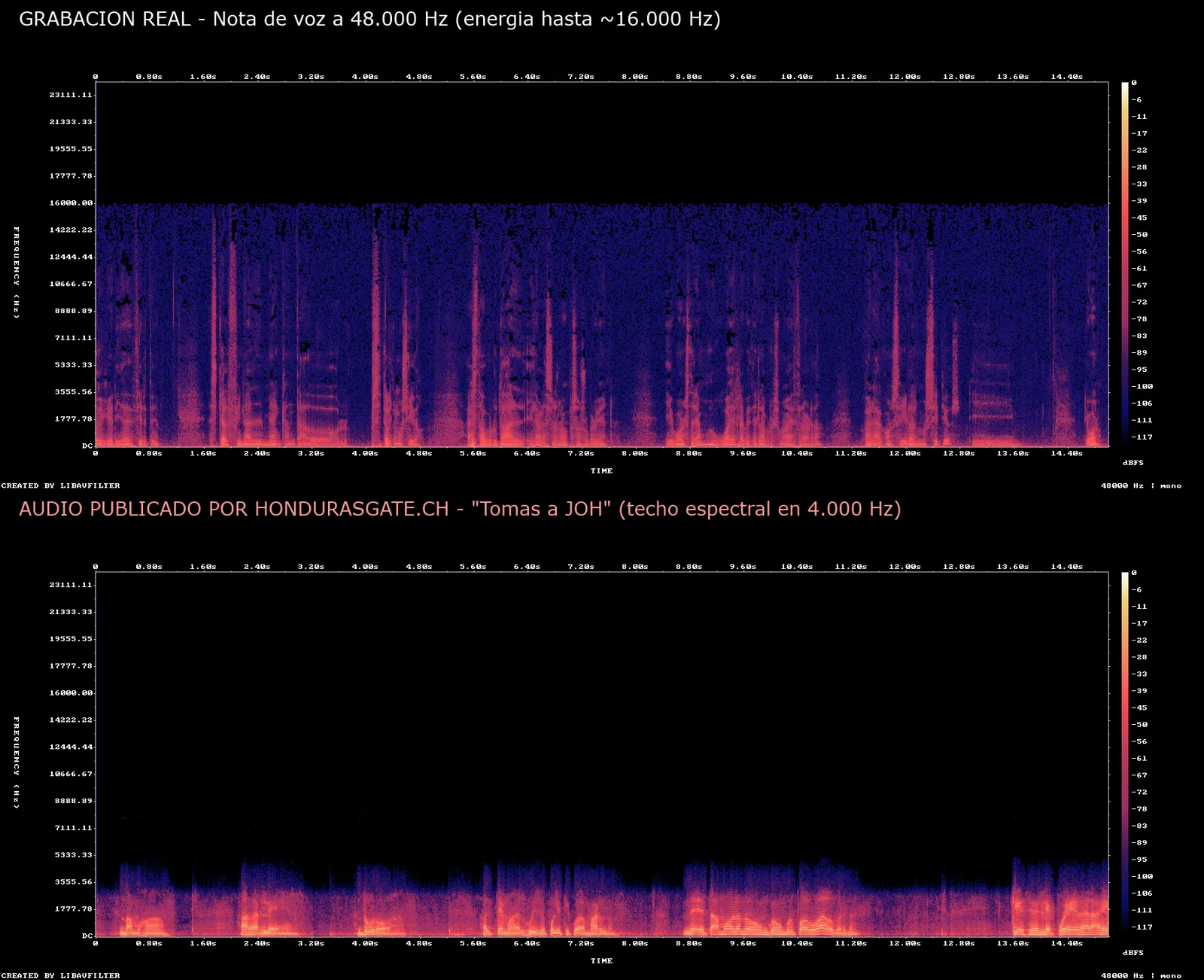
The visual comparison says it all: the spectrogram of a real voice note at 48,000 Hz shows energy up to ~16,000 Hz; the one for the audio published by hondurasgate.ch cuts off sharply at 4,000 Hz. All the black space in the lower half is the evidence their pipeline removed.
7Error 5 — The chain of custody does not exist
The reports present a SHA-256 hash as "chain of custody" for each file. But:
Problem 1: the hash is calculated on the degraded file, not the original.
Hondurasgate.ch's pipeline works like this:
- They receive the original audio (format and resolution unknown)
- They run it through their 9-step pipeline (including degradation to 8 kHz / 16 kbps)
- They calculate the SHA-256 of the file resulting from that process
- They publish that hash as "proof of integrity"
The hash proves nothing about the original audio. It only proves that the published file was not modified after degradation. It's like certifying the authenticity of a photocopy.
Problem 2: a self-published hash is tautological.
Hondurasgate controls both the file and the hash. A hash only has value as a chain of custody if it is generated by an independent third party at the moment the original material is received. Here, the same entity that publishes the audio is the one calculating and publishing the hash. It's as if a suspect signed his own alibi.
Imagine someone hands you a photograph and says, "I swear it's authentic — look at the serial number I put on it myself." That's what the hash does here.
8Error 6 — Biologically impossible metrics
Hondurasgate.ch's panel for the audio "Tomás a JOH: buscamos el delito…" ("Tomás to JOH: we're looking for the crime…") (hash 217dd2ca…, the same file from Section 7) presents biometric metrics alongside the "VOZ HUMANA CONFIRMADA" verdict. These metrics contradict themselves:
| Metric | Reported value | Normal human range | Possible? |
|---|---|---|---|
| Local shimmer | 71.96% | < 5% | ❌ NO |
| Jitter | 8.75% | < 1–2% | ❌ NO |
| HNR (harmonics-to-noise ratio) | −4.9 dB | > 10 dB | ❌ NO |
| Breathing events / minute | ~63 | 12–20 | ❌ NO |
The PDFs for other audio files show the same impossible pattern: shimmer between 53% and 72%, and negative HNR, across every file sampled.
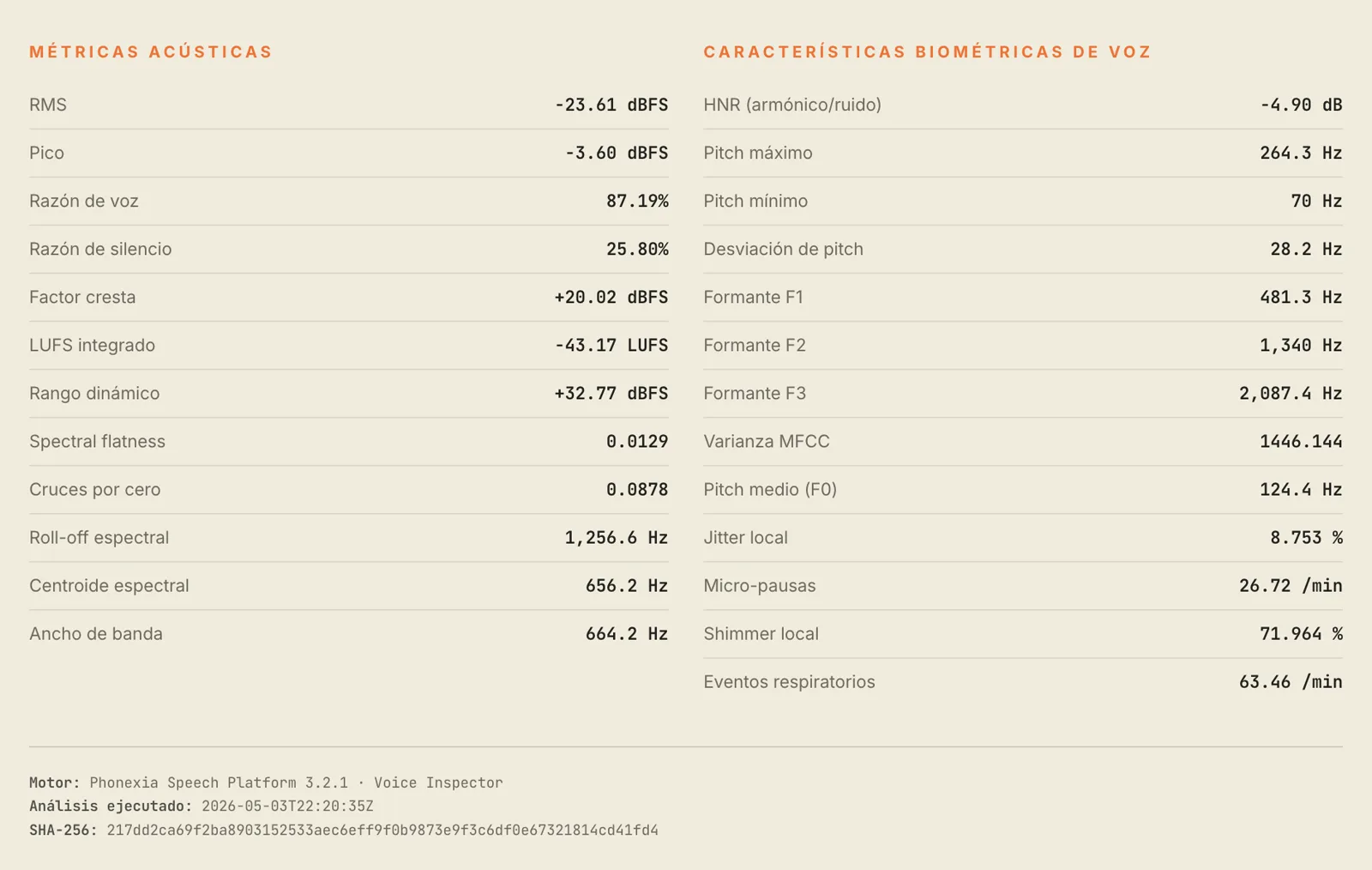
217dd2ca….Shimmer measures the amplitude variation between consecutive vocal cycles. In normal voice, it varies by less than 5%. A 72% value indicates severe vocal damage or corrupted audio. Jitter measures the fundamental-frequency variation between cycles. An 8.75% value is pathological — beyond the range of any documented voice disorder. HNR (Harmonics-to-Noise Ratio) measures how much of the audio's energy comes from voice versus noise. A negative value (−4.9 dB) means there is more noise than voice — the audio is essentially unintelligible. These values are inconsistent with the "VOZ HUMANA CONFIRMADA" verdict. Sources: standard vocal-pathology literature, the Journal of Voice, and Praat manuals (phonetic analysis software).
These values do not correspond to a healthy human voice, nor to an unhealthy one. They correspond to severely degraded or corrupted audio. And yet the report concludes "VOZ HUMANA CONFIRMADA" with 88.9% confidence.
The most likely explanation: the metrics are real calculations from an acoustic-analysis library (probably librosa in Python, which appears in the published methodology) run on the degraded audio, and the verdict is pasted on top regardless of what the numbers say.
9Error 7 — Copy-paste error in the template
The legal disclaimer at the bottom of every report reads:
"A verdict with 99.4% confidence…"
The PDF's own verdict states 88.0% confidence (and the web panel for the same audio, 88.9%). Neither figure matches the disclaimer.
It's a template error. The legal text was written for a generic example and never updated for each individual report. The 37 reports were probably generated automatically by a script that inserts the verdict into a fixed template — but someone forgot to parameterize the disclaimer.
It's a minor detail compared to the previous errors. But it reveals the level of carelessness: there was no human review of the reports before they were published.
10Error 8 — Decorative forensic labels
The reports include references to two international standards:
- ISO 27037 — Guidelines for the identification, collection, acquisition, and preservation of digital evidence
- ENFSI BPM — Best Practice Manual of the European Network of Forensic Science Institutes for speaker comparison
Both references are decorative:
- ISO 27037 requires that the chain of custody be established from the moment the original material is acquired. Here, the original files were never published, and the chain begins only after a degradation pipeline.
- ENFSI BPM covers speaker-comparison methodology (is Speaker A the same person as Speaker B?). Hondurasgate.ch's reports do not compare speakers — they claim to detect AI synthesis. The ENFSI standard does not apply to that question.
Including these acronyms in a report that follows neither standard is like displaying a vehicle-inspection sticker on a car that never went through the inspection.
11Demonstration: I cloned my voice and passed the verification
To demonstrate that the verification method used by hondurasgate.ch cannot tell a real voice from a synthetic one, I ran the following experiment with my own voice:
Step 1: creating a voice clone with ElevenLabs
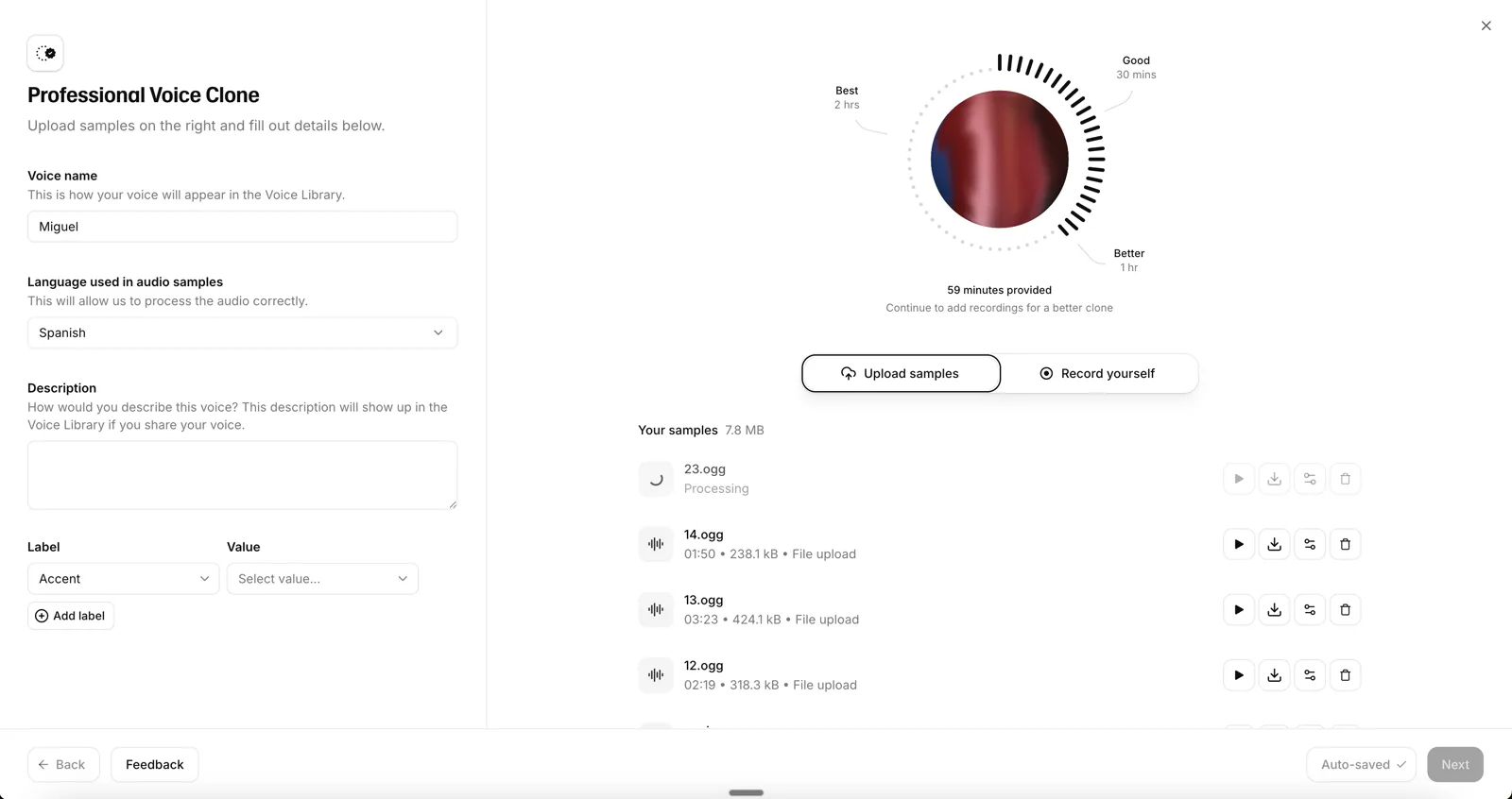
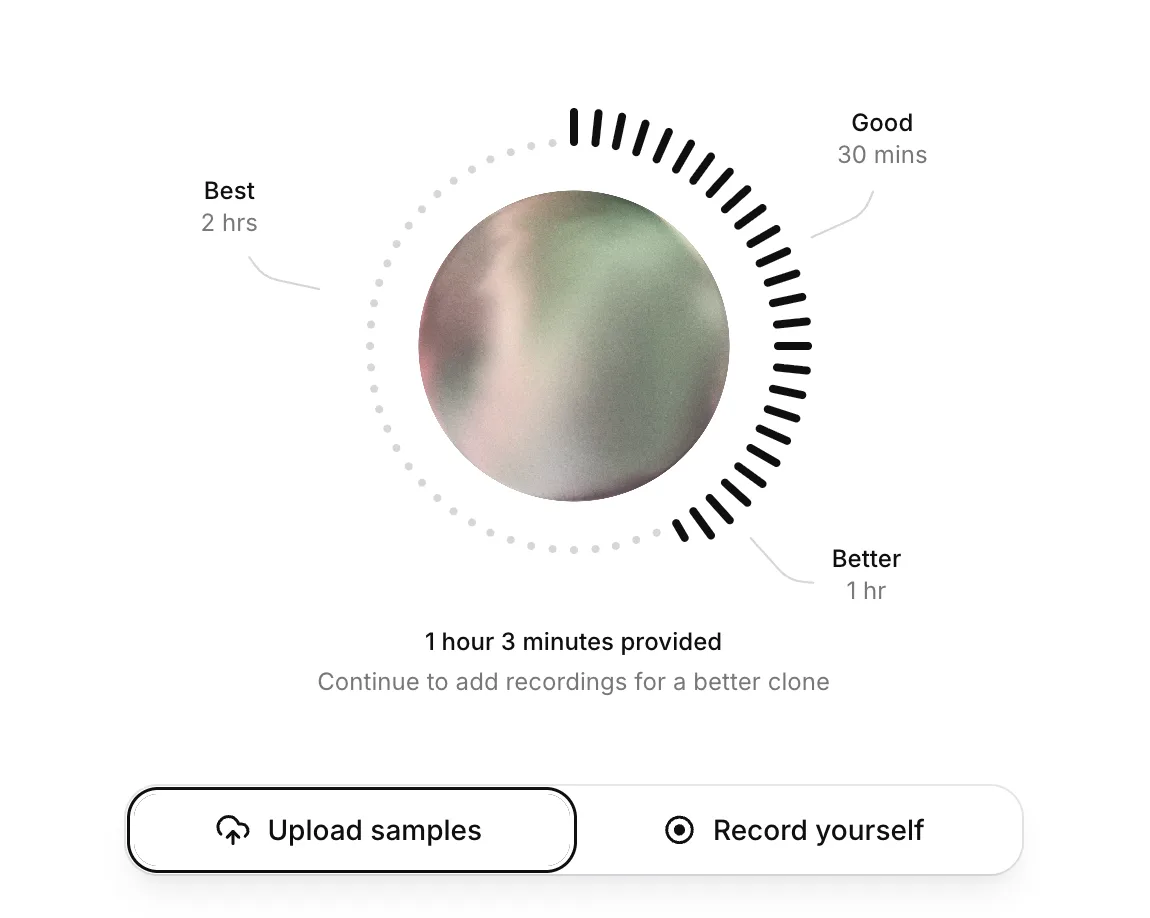
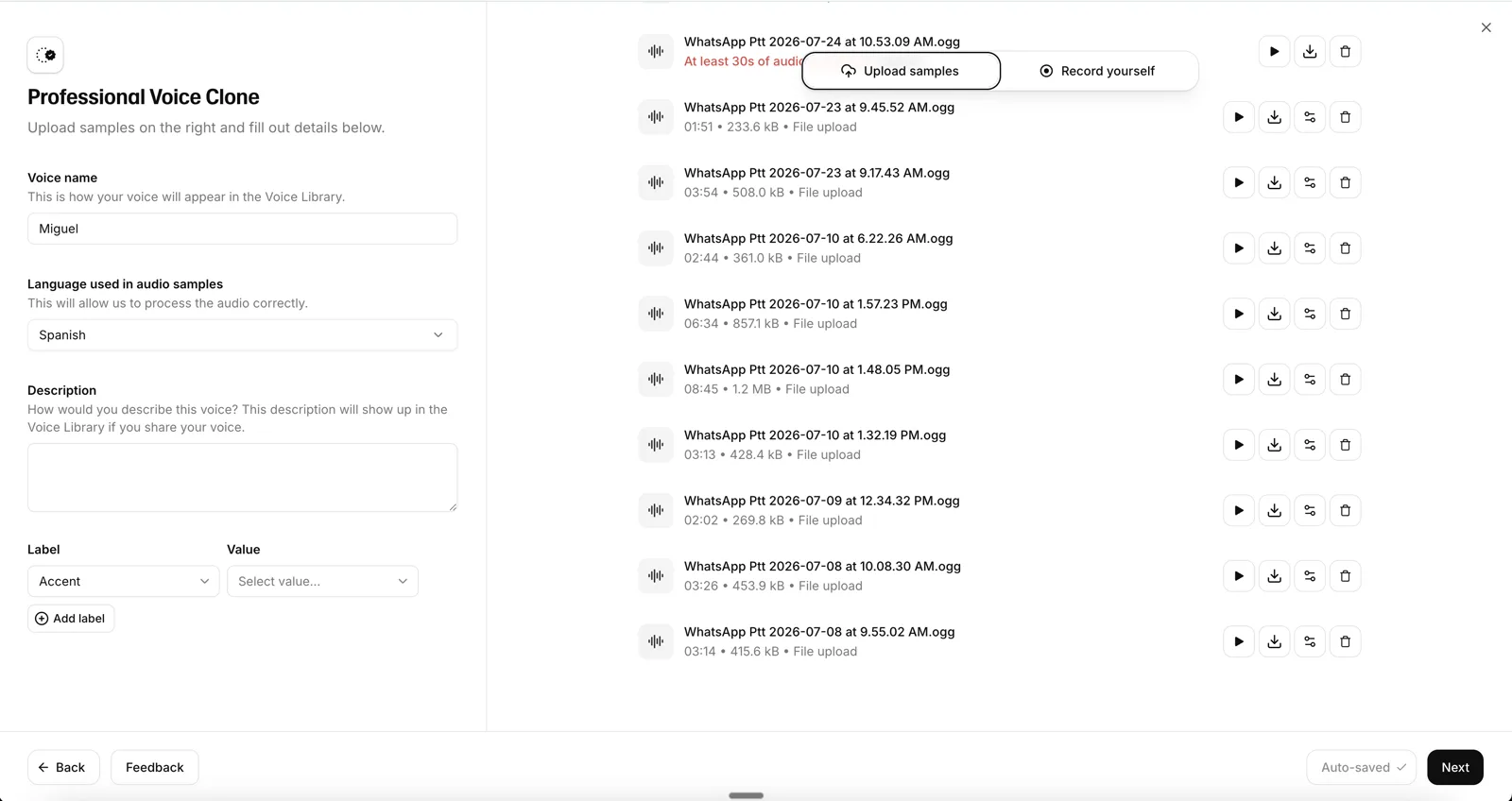
- Platform: ElevenLabs (elevenlabs.io)
- Method: Professional Voice Clone (fine-tuning the model on speaker samples)
- Training material: ~1 hour of WhatsApp voice notes in Spanish (my own recordings)
- Plan used: Creator ($22 USD/month)
- Setup time: under 1 hour (including uploading files and waiting for processing)
ElevenLabs is a commercial voice-cloning service. For $22 a month, anyone with an hour of someone's audio can create a synthetic copy of their voice that says whatever you type. No technical knowledge is required.
Step 2: generating synthetic audio
With my voice clone, I generated an audio clip of neutral text in Spanish. I then ran that audio through the same pipeline described in hondurasgate.ch's methodology: degradation to 8 kHz, re-encoding to Opus 16 kbps mono.
Step 3: sending it to Phonexia's REAL deepfake detector
I did not use hondurasgate.ch's fabricated interface. I used Phonexia's actual product: Phonexia Deepfake Detection, accessible through its demo/API.
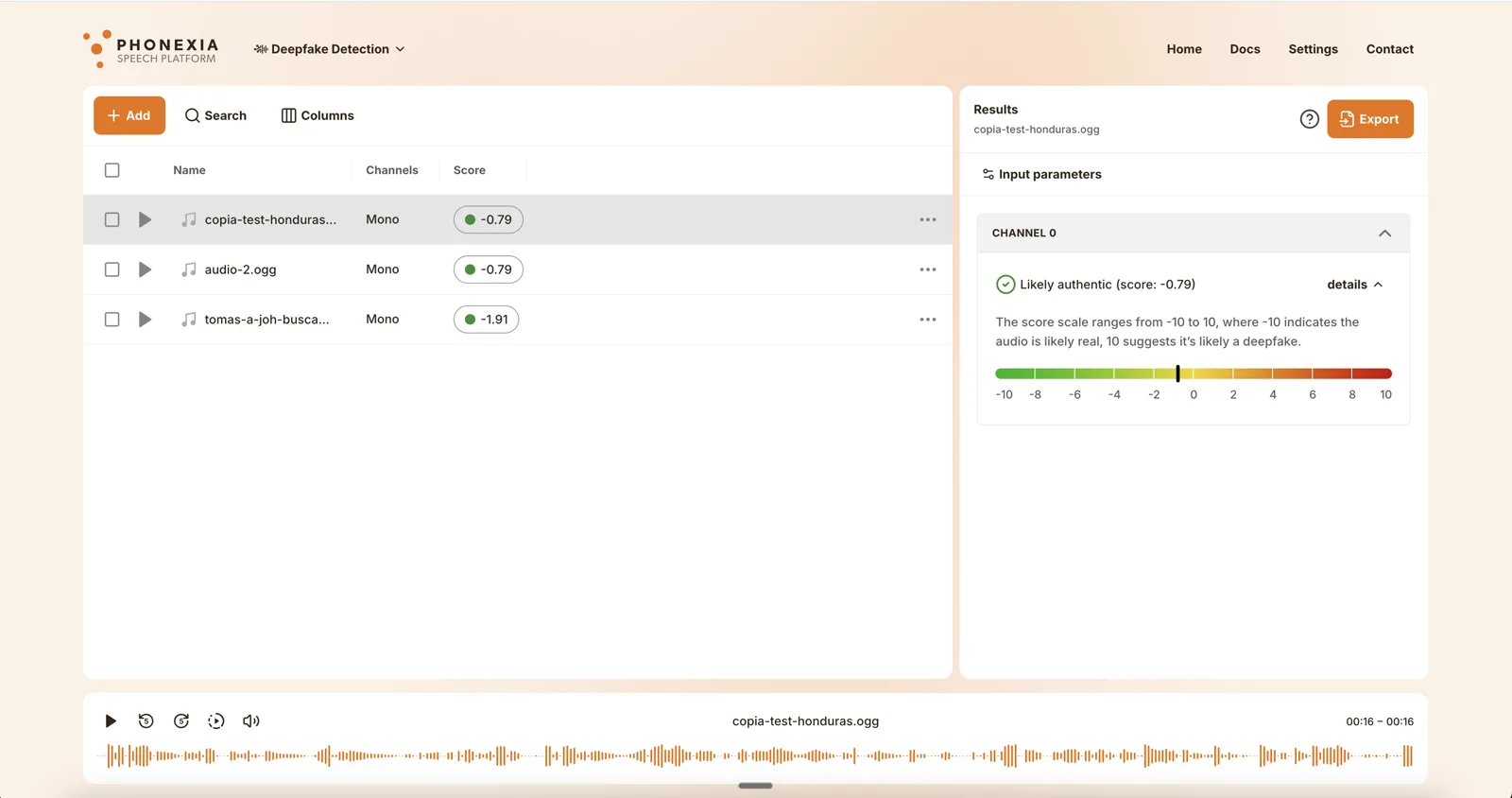
Result
| File | Phonexia score | Verdict |
|---|---|---|
| copia-test-honduras.ogg (my cloned voice) | −0.79 | 🟢 Likely authentic |
| audio-2.ogg (another synthetic sample) | −0.79 | 🟢 Likely authentic |
| tomas-a-joh-busca… (hondurasgate file) | −1.91 | 🟢 Likely authentic |
My AI-cloned voice got the same score as hondurasgate.ch's audio files on Phonexia's REAL detector.
The Phonexia Deepfake Detection scale runs from −10 (probably real) to +10 (probably deepfake). A score of −0.79 is classified as "likely authentic" — meaning Phonexia's real detector cannot tell my voice clone apart from real audio.
What does this prove?
It does not prove that hondurasgate's audio files are fake. It proves that a "human voice confirmed" verdict is not evidence of authenticity. If a voice clone created in one hour for $22 passes the same verification, that verification has no evidentiary value.
Total experiment costs
| Item | Cost |
|---|---|
| ElevenLabs Creator (1 month) | $22 USD |
| Access to Phonexia Deepfake Detection | $0 (free demo) |
| Total | $22 USD |
| Total time | < 2 hours |
12Earshot: what the independent analysis says (and doesn't say)
Drop Site News commissioned an independent analysis from Earshot (earshot.ngo), a British nonprofit specializing in forensic audio investigation, directed by Lawrence Abu Hamdan. There are two separate Earshot reports, and they should not be confused with each other.
Report 1 (May 2026): three files, moderate confidence
Commissioned by Drop Site News. Earshot analyzed three files (two of Hernández, one of Asfura) and concluded they are "authentic recordings of the voices of Hernández and Asfura, and were likely not generated by AI." It explicitly acknowledged:
- The confidence level is "moderate," not high.
- The quality of the three files is "limited due to their telephonic nature."
- They could not make a determination with certainty.
Method: analysis of "audio artifacts such as breaths, vocal hesitations, background noise, ambient noise, and microphone distortion," plus a machine-learning voice comparison using the Resemblyzer program — all on already-degraded files.
REF Drop Site News / Earshot Report 1: dropsitenews.com
Report 2 (July 25, 2026): twelve files, "highly likely"
A second, later report, also commissioned by Drop Site News (the expansion to twelve recordings was requested by an anonymous Honduran journalist), covers twelve recordings (six of Hernández, three of Asfura, two of María Antonieta Mejía, one of Cosette López) and concludes that all twelve are "highly likely" authentic and not AI-generated. This report does add two elements the first one lacked:
- A reproducibility framework in which Earshot trains a voice-cloning program to check which artifacts AI can and cannot reproduce (see Section 13).
- "Breath profile" matching: identifying breaths preceded by a lip or tooth click, cross-checked against known recordings of the speaker.
It's important to be precise here: the jump from "moderate confidence" (3 files) to "highly likely" (12 files) is not Earshot inflating its own findings — it's their own language in their own document. This report's critique is not that it overstates its conclusions, but that its methodology answers a narrower question than the one the headlines attribute to it (developed in Section 13).
REF Earshot Report 2 (July 25, 2026): earshot.ngo/investigations
What neither report did
- They did not verify the chain of custody or the origin of the files.
- They did not have access to the original files prior to degradation — they worked on the same 8 kHz OGG/OPUS files published by hondurasgate.ch.
- They did not reproduce the realistic attack (speech-to-speech conversion or splicing over real material from the speaker); they only tested text-to-speech generation (see Section 13).
- Report 2 itself explicitly recommends that a Spanish-speaking linguist analyze accent and dialect — something that, as far as is known, no one has done.
It's also worth noting hondurasgate.ch's own defense, contradictory as it is: it told Drop Site that it accessed Phonexia through "standard single-user and API commercial access" with no formal collaboration, while Diario Red spoke of access via the vendor's web console using external collaborators' credentials. Both versions cannot be true at once, and Phonexia denies any licensing relationship whatsoever.
The problem is not Earshot's honesty, which was considerable in both documents. The problem is how they are cited: headlines like "audio confirmed as authentic" collapse the nuance Earshot did include, presenting a verification of limited scope as a certification of total authenticity.
WITNESS Deepfake Rapid Response Force
Separately, WITNESS (a human-rights organization based in New York) mobilized its Deepfake Rapid Response Force — a network of ~40 media-forensics experts. Its findings on three hondurasgate.ch files, produced at the request of Criterio.hn, were mixed: one file probably real, two showing strong signs of AI manipulation (including possible voice cloning). The assessment itself warns that, given the technology's limitations, the results are not conclusive. WITNESS has not published a complete formal report.
REF Criterio.hn (June 8, 2026): criterio.hn
REF WITNESS DRRF: gen-ai.witness.org
13Earshot relies on an obsolete tool — and tests the wrong attack
Here is the underlying flaw, and it's a serious one. Earshot rests its verdict on two pillars: listening for artifacts, and a voice comparison with Resemblyzer. The first pillar — the claim that certain sounds (breaths, clicks, distortions) "AI cannot reproduce" — rests entirely on a single voice-cloning tool: Coqui TTS. And Coqui is a technical corpse.
The company Coqui AI shut down at the end of 2023. Its commercial services went dark in January 2024. The code was left behind as an abandoned community project, with no support or development, under a license (CPML) that doesn't even permit commercial use. Its model, XTTS-v2, was good for 2023 — three years ago, an eternity in this field. In 2026 it sits at the bottom of any serious ranking.
It's Earshot that uses Coqui, not hondurasgate.ch. Hondurasgate didn't even generate audio (it claims to detect synthesis using Phonexia — Sections 3–4). Coqui is the only generation tool Earshot names anywhere in its report (footnote 2 → the coqui-ai repository), and it uses it as a negative control — the yardstick it uses to decide what AI can and cannot do: it trains the model, observes which sounds it fails to imitate, and treats those sounds as proof of authenticity. Three uses: breaths with lip/tooth clicks (§2.1.1), microphone distortions (§2.1.3), and the overall reproducibility framework (§1).
And that's where the pillar collapses. When Earshot claims that "AI cannot reproduce" a given breath or a given distortion, all it has actually shown is that a discontinued 2023 model cannot reproduce it. Its finding says absolutely nothing about ElevenLabs, Fish Audio, CosyVoice 2, Chatterbox, or any tool a real forger would use today. It's a negative control that controls nothing.
There's a public arena where voice synthesizers go head to head and the public votes on which sounds more human. Coqui's model scores ~886. Today's leaders top 1,500 — captured live on August 10, 2026, the top five in the ranking score between 1,543 and 1,574. A free 82-million-parameter model (Kokoro, ~86 MB in its compressed version) that runs in your phone's browser beats it with ease. Earshot benchmarked against a third-tier regional team from three years ago and, from that, concluded that the entire 2026 league is incapable.
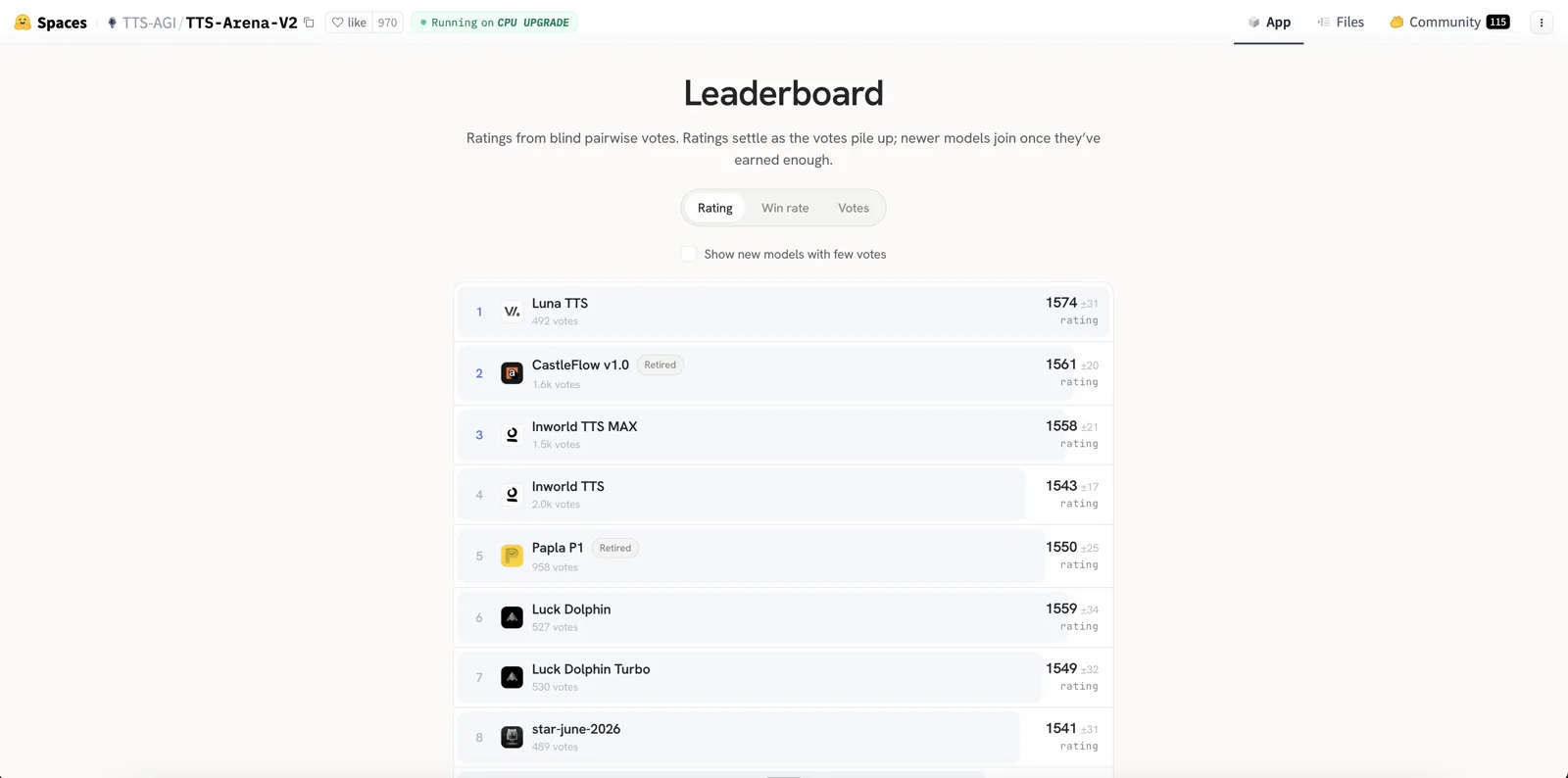
REF Coqui AI shutdown (GitHub Discussion): github.com/coqui-ai/TTS
REF TTS Arena V2, naturalness ranking (Hugging Face): huggingface.co/spaces/TTS-AGI
And it's even worse: it's the wrong attack
Even if the model were current, it would still be missing the essential point. Every one of Earshot's tests compares authentic material against text-to-speech (TTS) generation: text is fed to the model, and the output is checked for breaths, clicks, yawns, plosives, or room tone.
But that isn't the realistic attack against a public figure's leaked audio. The realistic attack is speech-to-speech conversion, or splicing over real audio of the speaker himself: a human actor — or JOH's own public audio, of which there is plenty — natively supplies every one of those artifacts, and only the timbre is synthetic. That's a cheaper attack, not a more expensive one, than the one Earshot actually tested.
Every Earshot test distinguishes authentic material from pure text-to-speech; none distinguishes an authentic conversation from a synthesis built on real material from the speaker. And this reaches the second pillar too: "breath profile" matching succeeds by construction if the fake is built from real JOH audio, and for the same reason a clone built on that audio is optimized to maximize exactly the similarity Resemblyzer measures. Both pillars measure what a well-made clone already comes with out of the box.
And their "low sample rate" argument is already refuted
Earshot treats the ~4,500 Hz ceiling as evidence in favor of authenticity: "Earshot's ongoing experiments have not encountered AI-generated audio with such a low sample rate" — while at the same time acknowledging that anyone can lower the sample rate by hand. That's an induction, and it's refuted with a single command line: the same pipeline from Section 6 (ffmpeg -ar 8000 -c:a libopus -b:a 16k -application voip -frame_duration 20) produces exactly that — audio cloned at 8 kHz, indistinguishable in artifact class from the degraded material. "We haven't seen it" is not "it can't be done."
In one sentence
Earshot's critical listening is well done; its anti-AI test is not. It is calibrated against a dead tool and against the attack no one would actually use. It competently answers an irrelevant question — "is this 2023 text-to-speech?" — and presents that as the answer to the only one that matters: "is this authentic?"
14Conclusions
The facts, in order:
- Phonexia was not involved. The company publicly denied it, demanded the removal of its name, and announced legal action. Hondurasgate admitted using it without authorization and deleted the references within five hours.
- They used the wrong product. Voice Inspector compares speakers. It does not detect deepfakes. The REST endpoint they claim to have used does not exist.
- The interface is fabricated. The visual "VOZ HUMANA CONFIRMADA" verdict is not the output of any Phonexia product. It's a hondurasgate.ch design.
- The audio was destroyed before analysis. Re-encoding to 8 kHz / Opus 16 kbps removes the frequencies where synthesis artifacts live. It's like analyzing a blurry photocopy and certifying the signature as authentic.
- The chain of custody is circular. The SHA-256 hash is calculated on the degraded file, not the original, and it is generated by the same party that publishes the audio.
- The metrics are physiologically impossible. 72% shimmer, 8.75% jitter, negative HNR, 63 breaths per minute. No human being produces these values. The verdict ignores them.
- It's a generic template with copy-paste errors. The legal disclaimer speaks of "99.4% confidence" when the PDF says 88.0% (and the web panel, 88.9%).
- The ISO/ENFSI labels are decorative. Neither standard was actually followed.
- A voice clone created in 2 hours for $22 passes the same verification. This does not prove the audio files are fake, but it does prove the verification does not prove they are real.
The outstanding challenge
If hondurasgate.ch's audio files are authentic, there is a simple way to prove it: publish the original files at the sample rate they were recorded at. WhatsApp records at a minimum of 16 kHz; Signal, at 44.1 kHz (and its desktop version, typically at 48 kHz). With the original files, independent experts could carry out genuine forensic analysis: examination of sibilants, harmonic structure, splice detection, background-noise consistency.
The fact that hondurasgate.ch's operators built a 9-step pipeline specifically designed to destroy high-frequency evidence before analyzing it — and then sealed the result with a SHA-256 hash and called it "chain of custody" — is a technical decision that deserves an explanation.
15Methodology and reproducibility
Everything presented in this report is reproducible. The steps to replicate the cloning experiment:
- Obtain ~1 hour of audio of your own voice (WhatsApp voice notes will do)
- Create a Creator account on ElevenLabs ($22/month): elevenlabs.io
- Use Professional Voice Clone to create a clone of your voice
- Generate a ~35-second audio clip with neutral text in Spanish
- Degrade the audio with ffmpeg:
ffmpeg -i input.wav -ar 8000 -c:a libopus -b:a 16k -application voip -frame_duration 20 output.ogg
- Send the file to Phonexia Deepfake Detection (demo available)
- Compare the score with the files published by hondurasgate.ch
The author invites any forensic expert, journalist, or researcher to reproduce these steps and independently verify the results.
16Sources and references
Official statements and primary documents
| # | Source | URL |
|---|---|---|
| 1 | Phonexia — Official statement on hondurasgate.ch (May 20, 2026) | phonexia.com/blog/… |
| 2 | Phonexia Voice Inspector — Product page | phonexia.com/product/… |
| 2b | Phonexia docs — Speech Platform 4, technology list (no "voiceinspector") | docs.phonexia.com |
| 2c | Phonexia docs — Voice Inspector (speaker comparison) | docs.phonexia.com |
| 2d | Phonexia docs — Deepfake Detection (separate product) | docs.phonexia.com |
| 3 | Hondurasgate — Forensic verification methodology | hondurasgate.ch/investigaciones/… |
| 4 | Wikipedia — Hondurasgate | en.wikipedia.org |
| 4b | Signal-Android — MediaRecorderWrapper.java (voice notes: 44,100 Hz mono, AAC-LC 32 kbps) | github.com/signalapp |
Independent analyses
| # | Source | URL |
|---|---|---|
| 5 | Drop Site News — Earshot Report 1, 3 files ("With Moderate Confidence") | dropsitenews.com |
| 5b | Earshot — Report 2, 12 recordings ("highly likely," July 25, 2026) | earshot.ngo |
| 6 | Earshot — Organization | earshot.ngo |
| 7 | WITNESS — Deepfake Rapid Response Force | gen-ai.witness.org |
| 7b | Criterio.hn — WITNESS assessment (1 real / 2 with signs of AI; inconclusive), June 8, 2026 | criterio.hn |
Journalistic investigations into the verification
| # | Source | URL |
|---|---|---|
| 8 | Dromómanos / Contracorriente — "Hondurasgate y la ilusión de verdad" ("Hondurasgate and the illusion of truth") | dromomanos.substack.com |
| 8b | Contracorriente (May 18, 2026) — "Phonexia niega el uso de su herramienta…" ("Phonexia denies use of its tool…") ("HG Forensics," five hours) | contracorriente.red |
| 9 | Memetic Warfare — "¿Donde Esta la Phonexia?" ("Where Is the Phonexia?") | memeticwarfare.io |
Coqui TTS and rankings
| # | Source | URL |
|---|---|---|
| 10 | GitHub — Coqui TTS shutdown discussion | github.com/coqui-ai/TTS |
| 11 | TTS Arena V2 — Hugging Face leaderboard | huggingface.co |
ElevenLabs
| # | Source | URL |
|---|---|---|
| 12 | ElevenLabs — Voice-cloning platform | elevenlabs.io |
| 13 | ElevenLabs — Pricing (Creator plan, $22/month) | Verifiable at elevenlabs.io/pricing |
Media coverage (selection)
| # | Source | URL |
|---|---|---|
| 14 | The American Prospect — "In Latin America, Trump Is Bringing Back That Old-Time Imperialism" (Aug 5, 2026) | prospect.org |
| 15 | La Jornada — Partial confirmation of authenticity | jornada.com.mx |
| 16 | People's World — Initial coverage | peoplesworld.org |